


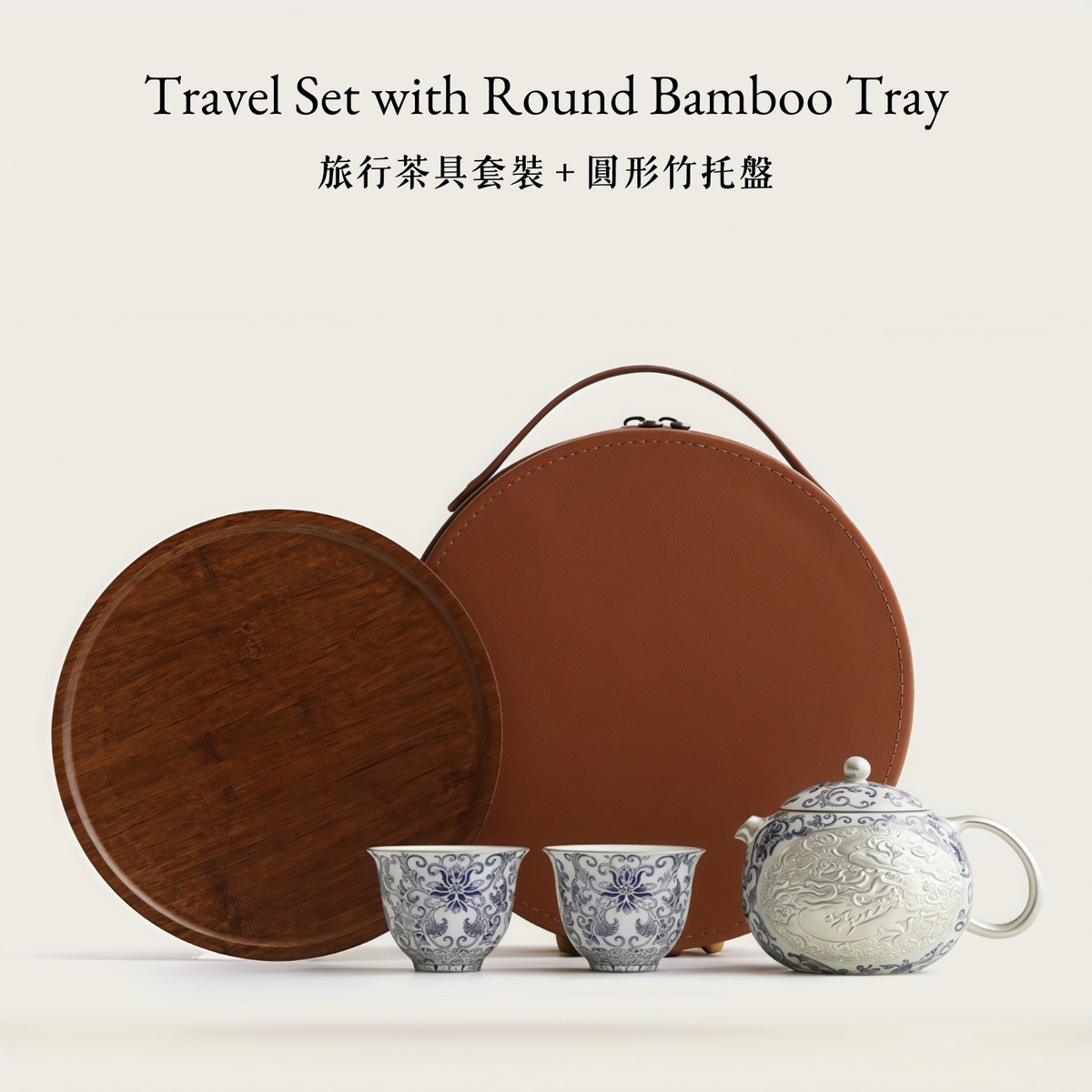
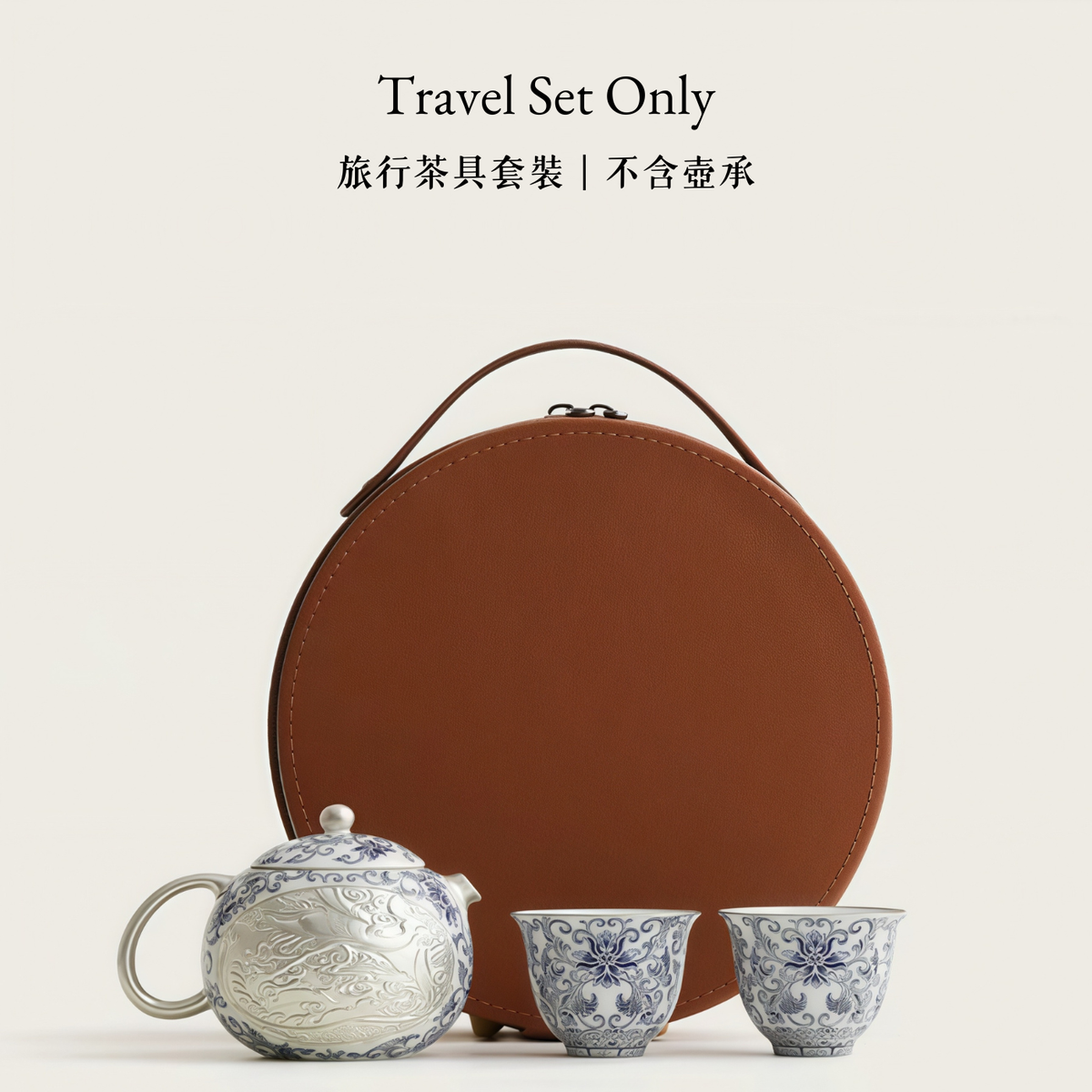
Moonlit Lotus | Handcrafted Pure Silver-Detailed Ceramic Travel Tea Set
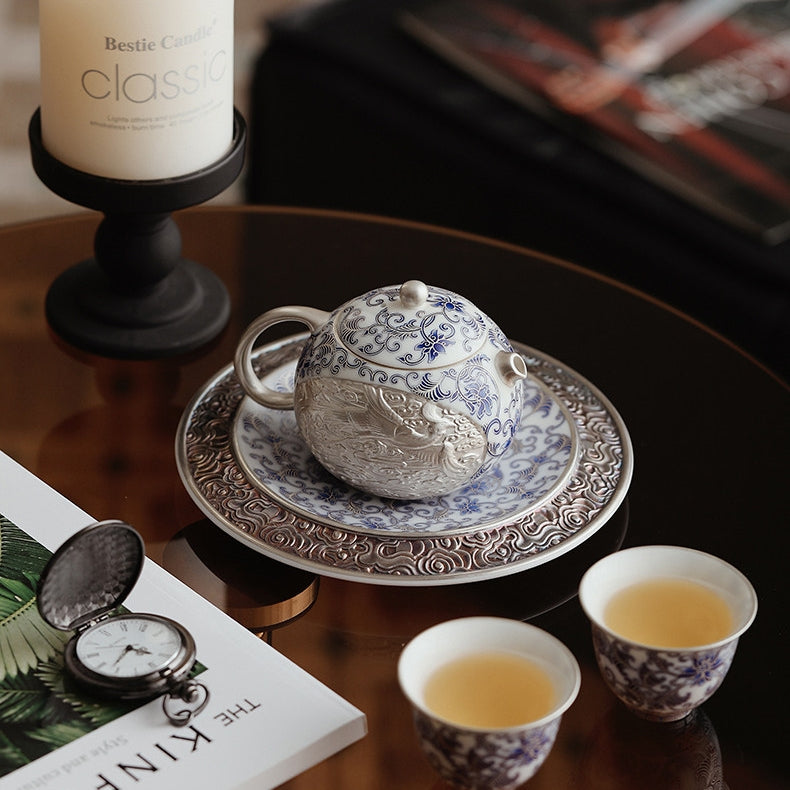
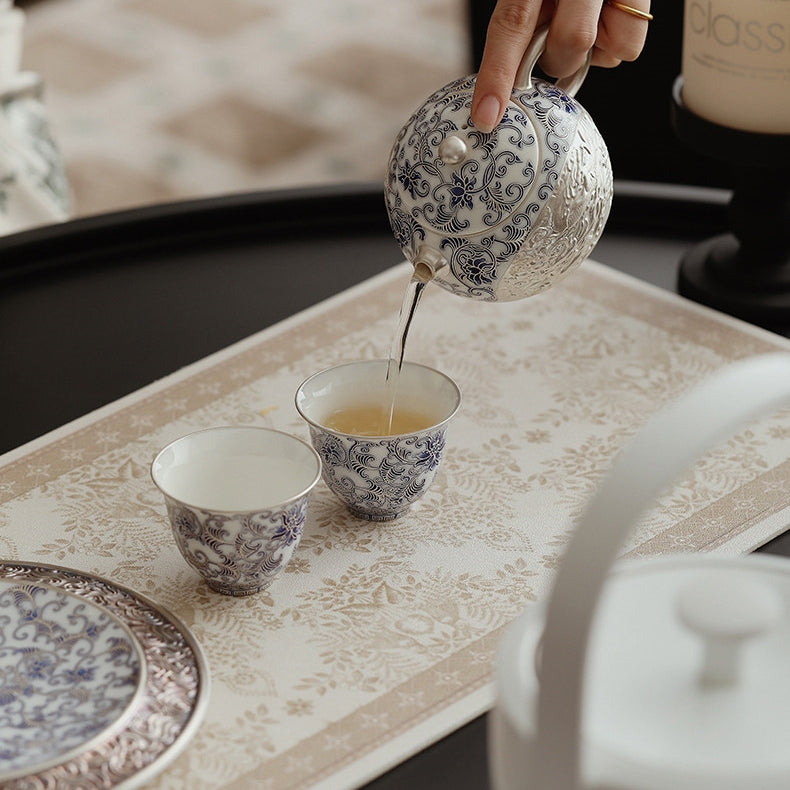
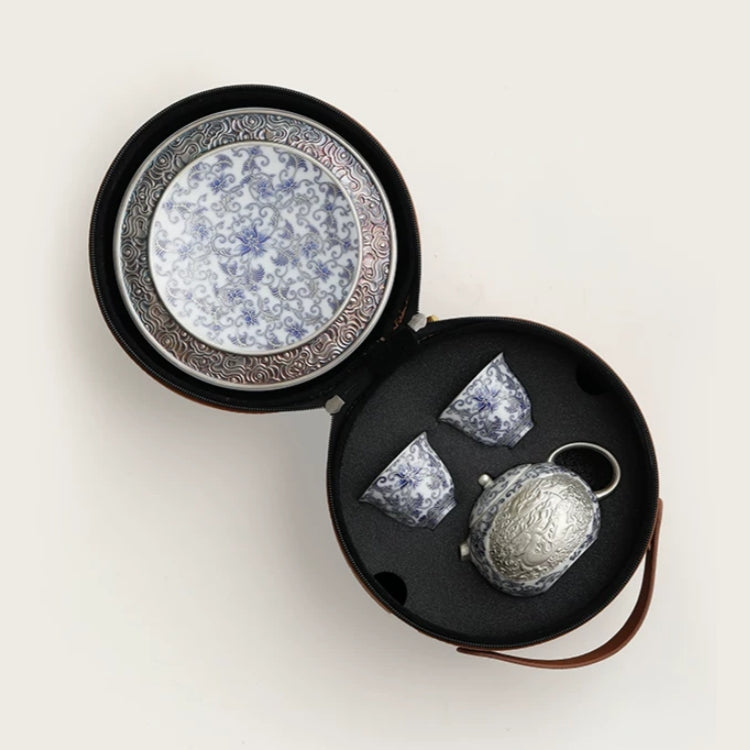
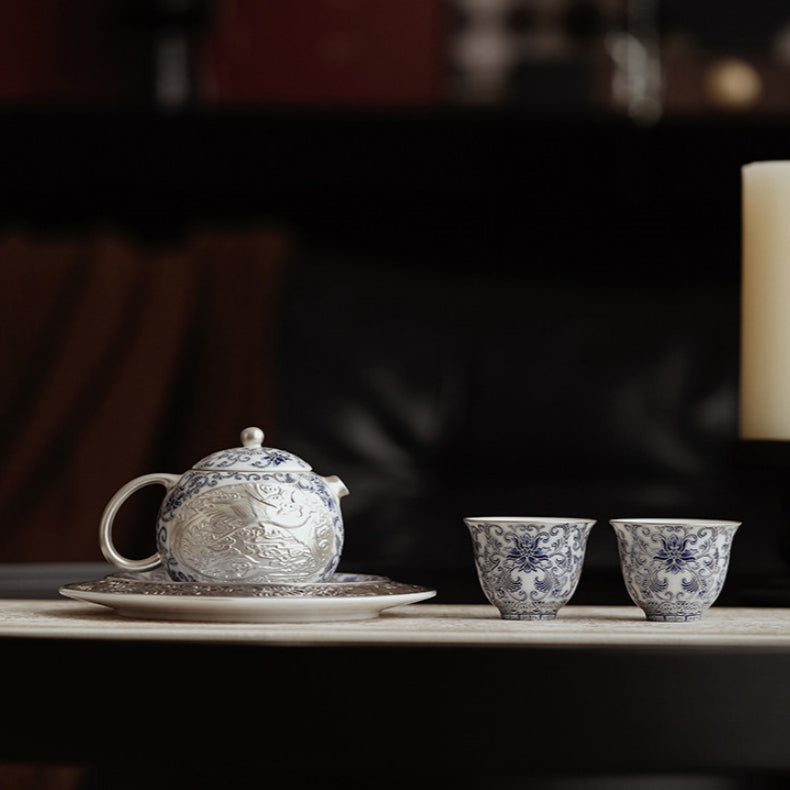
Moonlit Lotus brings together classical blue-and-white lotus ornament, genuine pure silver detailing and a compact travel-ready format in a ceramic tea set handcrafted in Dehua. Designed around the rounded Xi Shi teapot form (西施壺), the set includes a matching teapot, two coordinating cups, and a small round carrying case for convenient storage, gifting and travel.
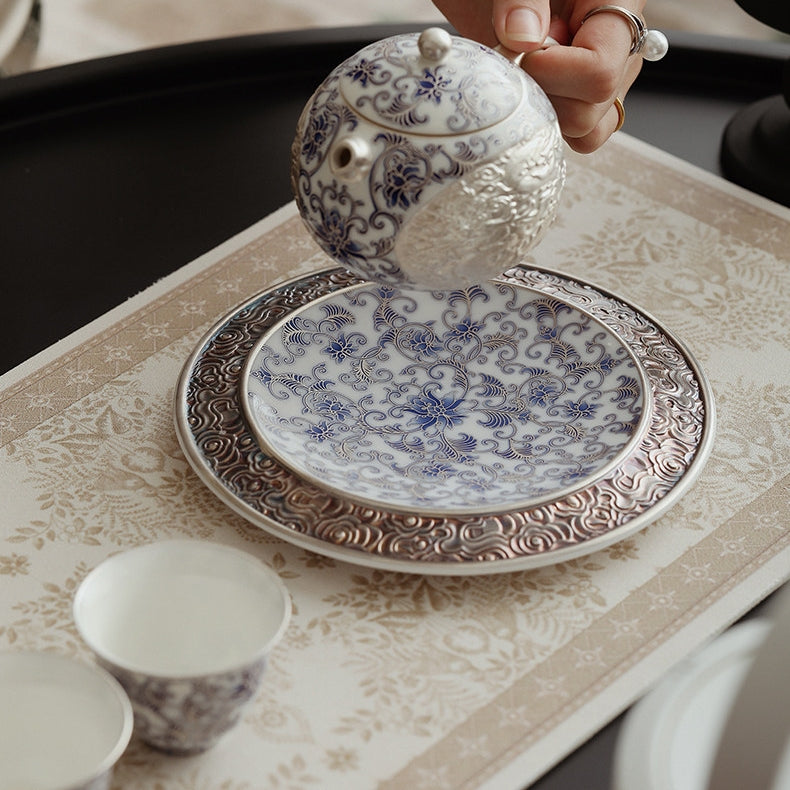
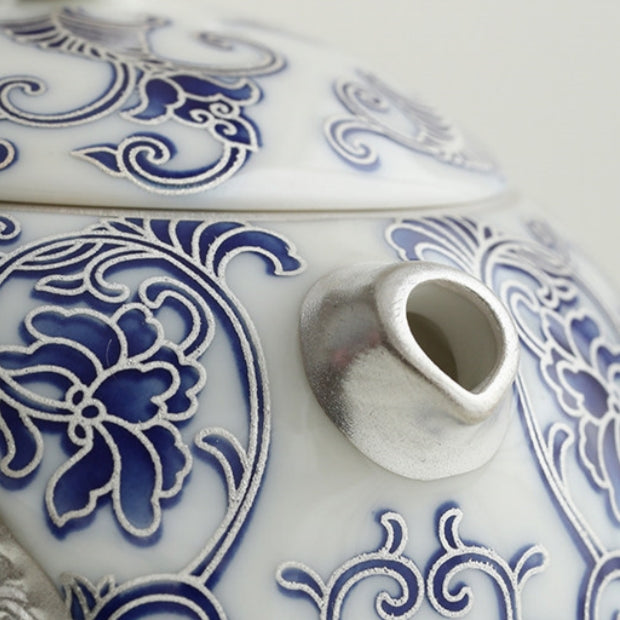
The teapot is decorated with the traditional scrolling lotus motif (纏枝蓮), with cobalt-blue lotus blossoms, curling leaves and continuous vines moving across the body and lid. The flowing floral pattern follows the natural curvature of the vessel, giving the surface a sense of rhythm and continuity associated with classical Chinese decorative arts.
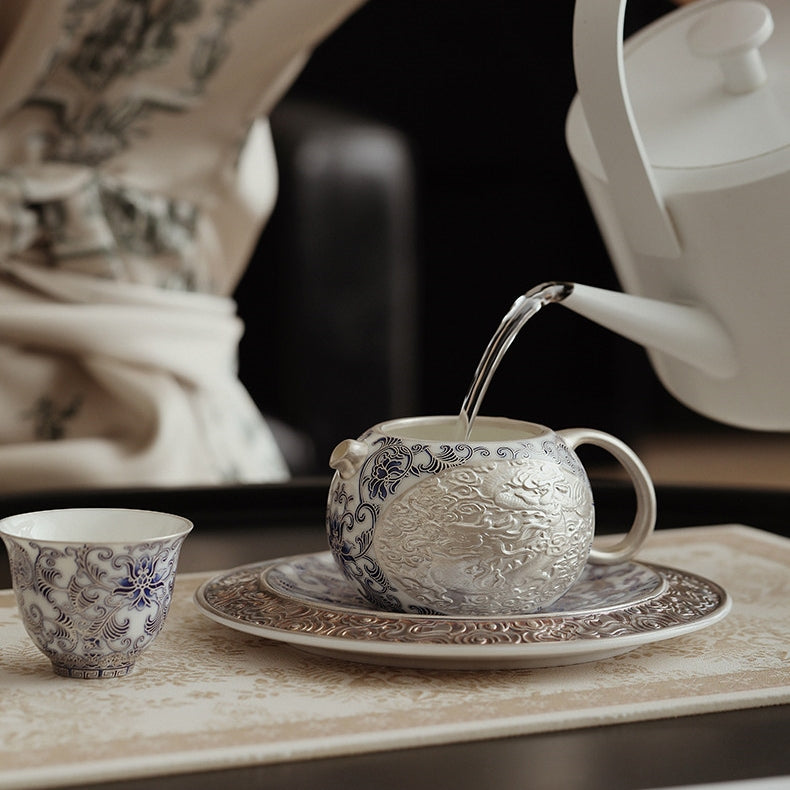
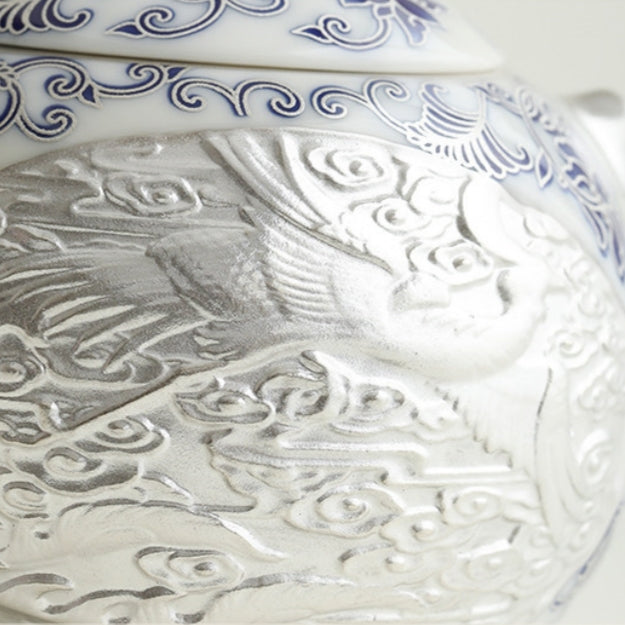
Selected areas of the teapot are further enriched with sculptural dragon and phoenix imagery, adding a more dimensional expression of two enduring auspicious symbols in Chinese visual culture. These raised decorative sections work in harmony with the scrolling lotus pattern, creating a layered composition that feels both refined and ceremonial.
Fine metallic outlines and relief accents are completed using traditional ceramic silver-cladding technique (陶瓷鎏銀), and pure silver is used in the 鎏銀 work. Applied across floral contours and the raised dragon-and-phoenix decoration, the silver introduces a quiet lustre that becomes more apparent as light moves across the surface.
Rather than overpowering the blue-and-white decoration, the silver works as a structural accent that gives the pattern more depth and a distinctly tactile presence. The combination of soft white ceramic, deep cobalt decoration and reflective silver creates a balanced finish that feels elegant without being overly ornate.
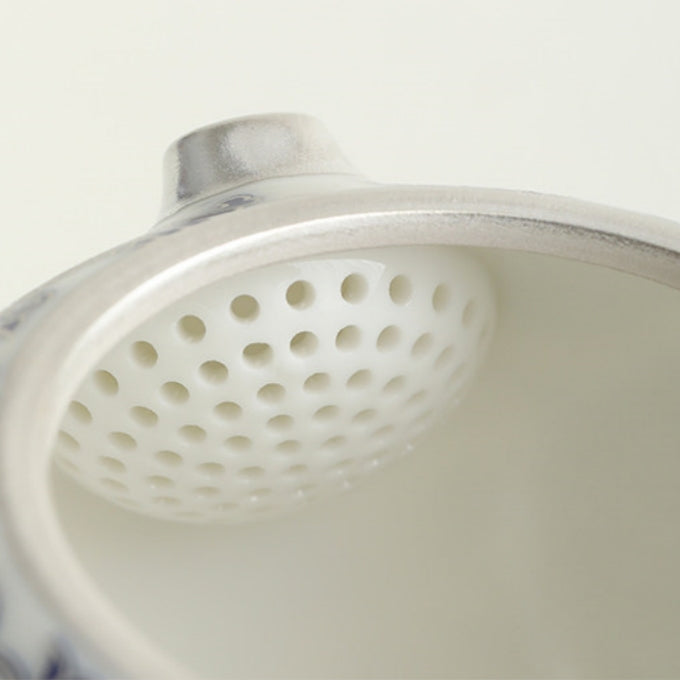
The rounded teapot is fitted with an integrated hemispherical multi-hole filter behind the spout to help retain loose tea leaves while allowing the liquor to pour cleanly and evenly. Its compact body offers enough room for leaves to open during steeping, while the short spout and curved handle support controlled pouring for Gongfu-style brewing.
With an approximate capacity of 200 ml, the teapot remains compact enough for personal tea sessions or sharing between two people. Two matching Bell Cups complete the set, each carrying the same blue-and-white scrolling lotus design with pure silver detailing in a smaller companion form.
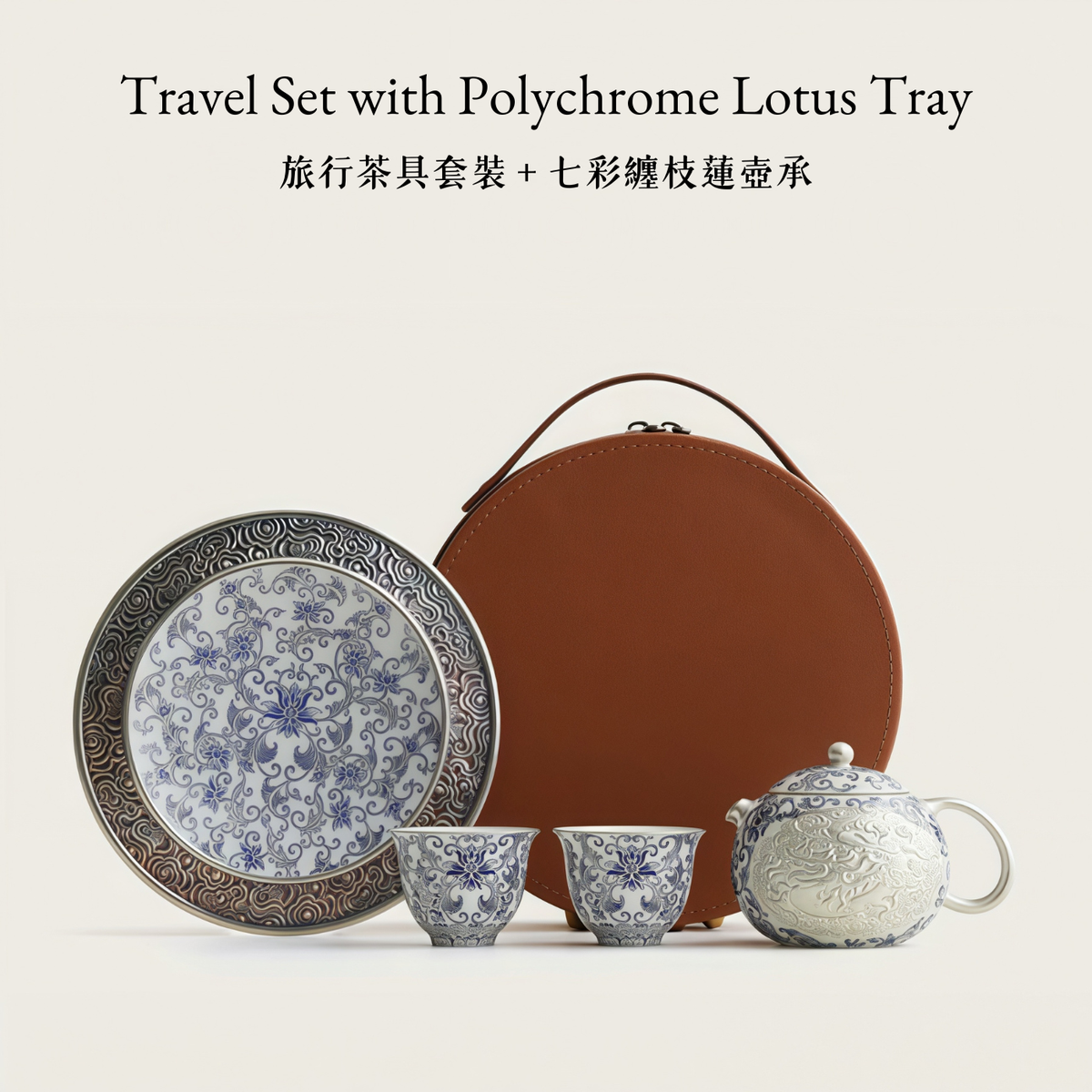
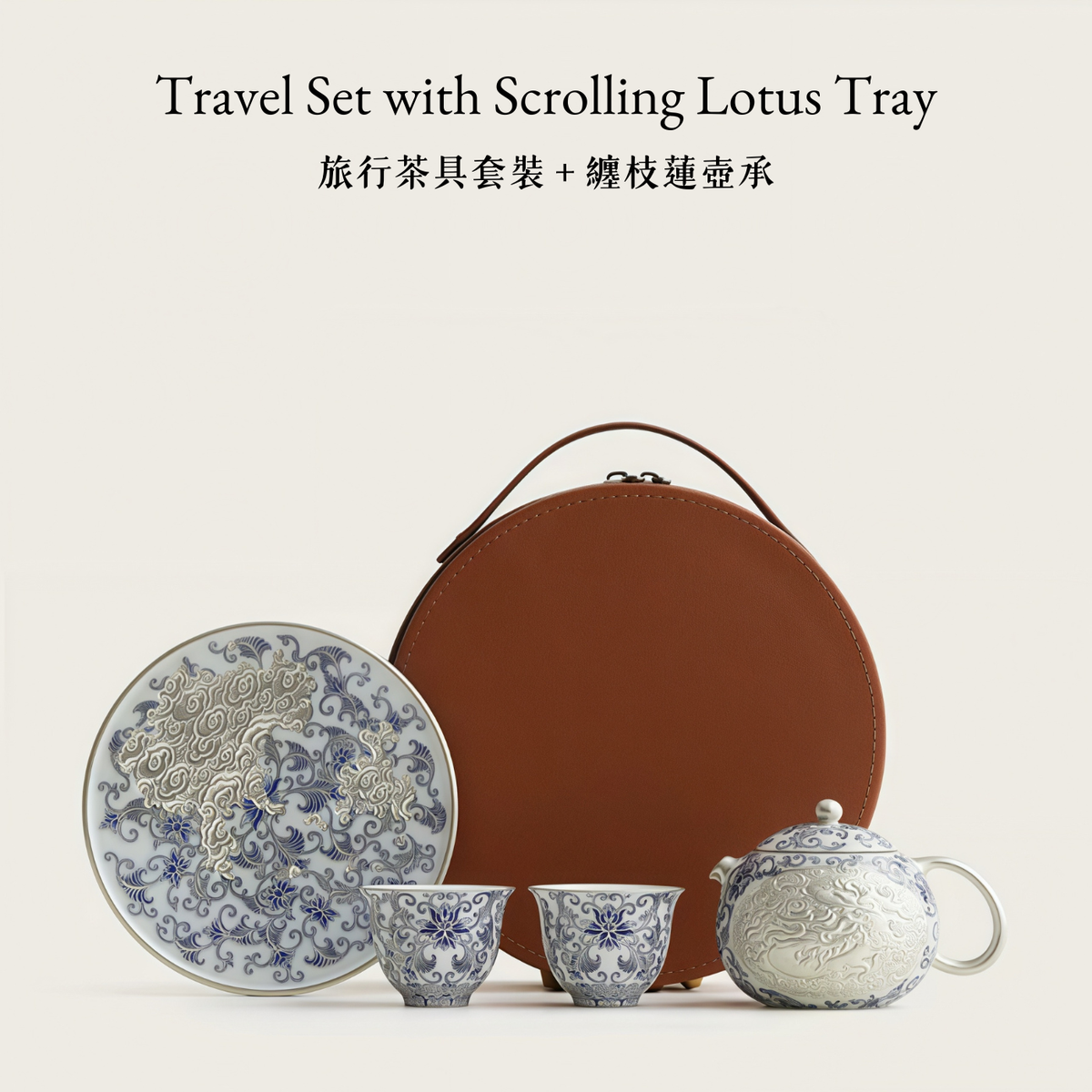
To support different presentation preferences, the set is available on its own in the round travel case or paired with one of several coordinating tray options. The Scrolling Lotus Teapot Tray continues the restrained blue-and-white floral language, the Polychrome Scrolling Lotus Teapot Tray offers a richer and more decorative presentation, and the Round Bamboo Tray introduces a warmer, more understated natural contrast.
A compact round carrying case completes the set, making Moonlit Lotus especially suitable as a portable travel tea set. Whether used for quiet brewing at home, on the go, or as a refined gift, it brings together Dehua craftsmanship, traditional symbolism and genuine pure silver detailing in a practical, self-contained format.
• Origin: Made in Dehua
• Product:
1 × Ceramic Teapot
2 × Ceramic Teacups
1 × Optional Teapot Tray, according to selected style
1 × Round Travel Carrying Case
Handcrafted in Dehua with traditional ceramic-making methods, each with a unique design and texture.
Times
Orders take 2-3 business days to process after placing the order before shipping out.
Standard Shipping Times
• North America
United States (Mainland): 5 - 12 days
Alaska, Hawaii, and other US regions: 10 - 20 days
Canada: 5 - 14 days
Mexico: 10 - 17 days
• Europe: 5 - 12 days
• Australia/New Zealand: 6 - 14 days
• Asia
Southeast Asia: 5 - 8 days
Other Regions: 5 - 14 days
• Latin America: 10 - 20 days
• Other Countries: 10- 20 days
Express Shipping Times: 4 - 8 days
Available for Selected Products in the Following Countries:
• United States(Mainland)
• United Kingdom
• France
• Germany
• Italy
• Austria
• Spain
• Netherlands
Priority Shipping Times: 3 - 5 days
Available for Selected Products in the Following Countries:
• United States(Mainland)
• Canada
• United Kingdom
• France
• Germany
• Italy
• Austria
• Spain
• Portugal
• Netherlands
• Australia
• New Zealand
• United Arab Emirates
• Saudi Arabia
We offer a 7-day return & exchange policy. For detailed information Return, Refund & Exchanges
Choose options

A Legacy Of Porcelain
Dehua: Over 3,700 Years Of Ceramic Tradition
For more than 3,700 years, ceramics have shaped the cultural identity of Dehua in Fujian, China. Archaeological discoveries show that primitive celadon was already being produced in the region during the Xia and Shang periods, placing Dehua among the important early centres of Chinese ceramic culture.
During the Song and Yuan dynasties, Dehua porcelain became an important export along the Maritime Silk Road. By the Ming dynasty, its exceptionally refined white porcelain had achieved international recognition, later becoming known in Europe as Blanc de Chine, or “White from China”.
Yet Dehua’s ceramic tradition extends far beyond white porcelain. Across centuries, its artisans have produced celadon, blue-and-white porcelain, coloured glazes, sculptural works and richly decorated vessels. Today, this long heritage continues through both traditional craftsmanship and contemporary ceramic design.

From Earth To Form
Preparing The Porcelain Clay
The making of Dehua porcelain begins with carefully prepared clay. The raw material is refined, mixed and rested until its moisture, purity and consistency are suitable for forming. The stability created at this stage influences every process that follows, from shaping and trimming to decoration, glazing and firing.
For moulded works, the clay may be prepared as liquid slip and poured into plaster moulds. A fine layer gradually forms against the inner surface, creating an even porcelain body that can later be removed, refined and assembled by hand.
Careful preparation gives the porcelain body the consistency and strength required for the craftsmanship that follows.

Shaped By Hand
Form Begins With Balance
Depending on the design, Dehua porcelain may be thrown on the wheel, shaped by hand or formed using moulds. For teaware, wheel throwing establishes the vessel’s volume, curve and proportion through a series of small, controlled movements.
The artisan must understand how the clay responds while it remains soft and workable. Changes in pressure, speed or hand position can alter the wall thickness, symmetry and balance of the finished form.
What appears effortless on the wheel is supported by years of experience. The aim is to create a body that feels refined and light while retaining the strength required for the stages that follow.


Refined By Touch
Precision In Every Curve
Once the porcelain body has partially dried, it is carefully trimmed to refine its profile, thickness and foot. Excess material is removed gradually until the vessel reaches the intended balance between lightness, strength and proportion.
This is a process measured through both sight and touch. Removing too much clay can weaken the body, while leaving too much can make the finished piece feel heavy.
For teaware, these subtle adjustments also influence how the vessel sits, pours and feels in the hand. Precision at this stage creates the quiet refinement visible in the finished form.

Detail By Hand
Where Character Takes Shape
Once the form has been refined, decoration gives each piece its individual character. Depending on the design, artisans may carve, incise, model, paint or apply decorative details directly to the porcelain body.
Dehua craftsmanship ranges from intricate relief and sculptural work to hand-painted motifs, underglaze decoration and finely worked surface details. Each technique requires control, as every line and texture must remain clear through glazing and firing.
Whether restrained or richly ornamented, these details transform the porcelain from a functional form into a distinctive finished piece.

The Art Of Glaze
Colour, Depth And Surface
Glaze plays a defining role in the final character of Dehua porcelain. Applied before firing, it influences colour, translucency, texture and the way light moves across the finished surface.
Different pieces call for different expressions, from clear and softly luminous glazes to celadon tones, richer coloured finishes and surfaces designed to complement painted or gilded decoration. The thickness and evenness of the glaze must be carefully controlled so that it enhances rather than obscures the underlying form.
During firing, glaze and porcelain body fuse together, revealing a surface that may be quiet and restrained or rich with colour and depth.


Transformed By Fire
Where Fire Completes The Form
Firing is the decisive transformation in porcelain making. Inside the kiln, intense heat vitrifies the porcelain body and fuses it with the glaze, revealing the final colour, texture, density and character of the piece.
Temperature, kiln atmosphere, placement and timing can all influence the result. Painted decoration develops its final tone, glazes reveal their depth and surface, and the porcelain body gains the strength and resonance associated with high-fired ceramics.
Even after every earlier stage has been completed with precision, the finished result is only fully revealed once the kiln has cooled. Dehua’s long history of kiln firing remains one of the foundations of its ceramic tradition.

Revealed At Last
From Clay To Porcelain
Only after firing and cooling does the complete character of the piece emerge. Form, glaze, colour and decoration come together, revealing the result of every decision made throughout the process.
Dehua porcelain can take many expressions, from the luminous restraint of Blanc de Chine to blue-and-white painting, celadon and coloured glazes, gilded decoration and contemporary designs. What connects them is the same foundation of carefully prepared material, skilled craftsmanship and generations of porcelain-making knowledge. Dehua’s own historical record reflects this diversity, from early celadon and Song-Yuan qingbai wares to Ming white porcelain and the flourishing of blue-and-white and polychrome porcelain in later periods.
For teaware, refinement must also remain functional. A well-made vessel should feel balanced in the hand, comfortable in use and harmonious on the tea table.
What began as raw clay has become porcelain, shaped by human touch, transformed by fire and given its final character through craft.
